
- This event has passed.
Etruria Marl: what it is; how it formed; why it’s special – Dr Bernard Besley
September 17, 2026 @ 7:15 pm – 9:00 pm
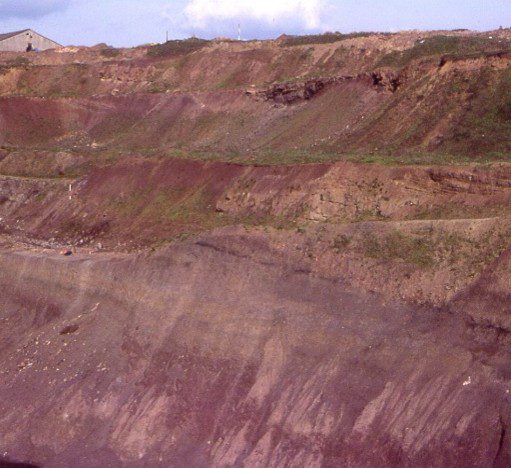
In the English Midlands the term ‘Marl’ has meant, from time immemorial, any clay from which bricks can be made. The Etruria Marl is thus not a marl in the geological sense of the word, but a raw material formed by the red mudrocks of the Westphalian Etruria Formation, a marginal alluvial red-bed facies of the Langsettian to Bolsovian Productive Coal Measures. Etruria Marl is one of the most important heavy ceramic clays in the UK, being the dominant source of clay suitable for making high strength engineering bricks. It is favoured by the industry for its ease and flexibility of working, its low embodied CO2 content and its fast and fuel-efficient firing characteristics.
The ‘Marl’ of the Etruria Formation is a kaolinite-dominated, iron-rich silty claystone deposited at equatorial latitudes during a period of high global atmospheric oxygen. Its mineralogical characteristics derive from lateritic weathering in fault-bounded uplifts created during the first phase of Variscan deformation. Progressive deformation and uplift led to the northward spread of this facies into the southern part of the Pennine Basin, with complex intra-formational unconformities creating a syn-orogenic molasse. Depositional environments included alluvial plains with meandering channels and alluvial fans. Throughout the Etruria Formation hiatal periods are marked by complex palaeosols which lead to marked variability in the bulk composition of the clay.
While the Etruria Marl is best known in its type area in North Staffordshire, it has been – and still is – extensively worked in Warwickshire. Here its stratigraphic relationships have been poorly understood, but new borehole and seismic data allow some light to be cast on the sedimentological and tectonic events that accompanied its deposition.
The distinctive ceramic properties of the Marl derived from its ‘residual’ composition. The dominant kaolinite allows for the formation of a mullite-dominated ceramic matrix, while a small proportion of illite allows easy workability and prevents the clay from having refractory properties. A unique feature is the high iron content, which, apart from allowing the production of aesthetically pleasing fired products, allows partial melting at a late stage in firing on application of a reducing atmosphere. This stimulates the growth of fibrous mullite, producing the immensely strong semi-vitrified brick known as a ‘Staffordshire Blue’. The combination of high strength and low permeability made the Staffordshire Blue a major material for heavy civil engineering construction in the age before reinforced concrete.
The last 10 years have seen a renewed interest in Etruria Marl, following recognition that calcined kaolinite forms a pozzolanic material that is a viable feedstock for the production of LC3 cement. This cement formulation allows for a c. 45% reduction in the CO2 emissions in cement making, and is seen as an important contributor to the decarbonisation of that industry.
The talk will outline the general palaeogeographic and sedimentological evolution of the Etruria Formation, followed by a whirlwind tour of its properties and applications in ceramic and cement manufacture. If time allows, it will conclude with a review of the resource position as it relates to major substitution of ‘conventional’ cement raw materials by Etruria Marl.
Biography
Bernard studied at the University of Oxford, receiving a BA in Geology in 1976. He then came to Keele as a Ph.D. student working on the sedimentology and stratigraphy of red beds in the Westphalian of Central England, in collaboration with the National Coal Board. Between 1980 and 1985 he worked for Shell UK Ltd as an exploration geologist, undertaking wellsite duties in the North Sea and being involved in regional play fairway analysis and detailed prospect mapping leading to the discovery of the Galleon and Ketch gas fields in the UK Southern North Sea. In 1985 he returned to Keele as Lecturer in Sedimentology, where he continued his work into regional controls on late Carboniferous basin development in NW Europe. In 1996 he returned to the oil industry, spending another 5 years with Shell before setting up a freelance consultancy business. In that time he has worked on clastic hydrocarbon reservoirs of all ages and environments, being mainly concerned with the process of translating sedimentological models into numerical reservoir static models that can be used in a meaningful way for reservoir engineering purposes. He has also undertaken several stratigraphic and quality assessments of brick clays in the Late Carboniferous of the English Midlands, being an authority on the geology of the Etruria Formation. Since leaving Keele in 1996 he has continued his association with the Keele geoscience department through his Honorary Fellowship.
This lecture will be offered in a hybrid format. Please join us in person if you can, or register to attend virtually via zoom using the link below.
Register in advance to attend virtually:
https://us02web.zoom.us/meeting/register/IX-lltB3SGa-w5Cx0HX5Fg
Venue:
St Francis Of Assisi RC Church, 110 Warwick Rd, Kenilworth CV8 1HL
https://maps.app.goo.gl/9CGWRNdgFfttDKtd7