Report and photographs by Ray Pratt and Peter Hawksworth
GULLET QUARRY: This weekend trip began in the Southern Malvern Hills at Gullet Quarry taking in the breathtaking beauty of the area with a 4 km circular walk via Hangman Hill. Regrettably, the geological exposures were poor.
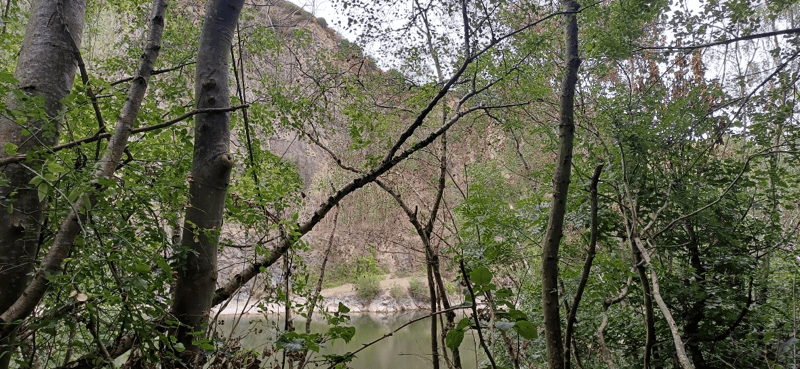
At Gullet Quarry we were to take a look at the unconformity between the Pre-Cambrian Malvernian and the overlying Silurian Wyche Formation deposits. The Malverns Complex at this site is a grey cataclasite*. The rock is schistose and contains bands of the mineral’s quartz and feldspar, which are separated by thin laminae of the mineral’s muscovite and chlorite. It is these two minerals that give the rock a schistose texture.
* A cataclasite is a cohesive, non-foliated fault rock formed by brittle deformation and mechanical crushing of pre-existing rocks under moderate pressure and temperature conditions in the upper crust.
The locality, has considerable local importance in demonstrating the nature of the Early Silurian sediments and their stratigraphical relationships, and provides significant evidence for the position of the late Llandovery eastern shoreline of the Welsh Basin.
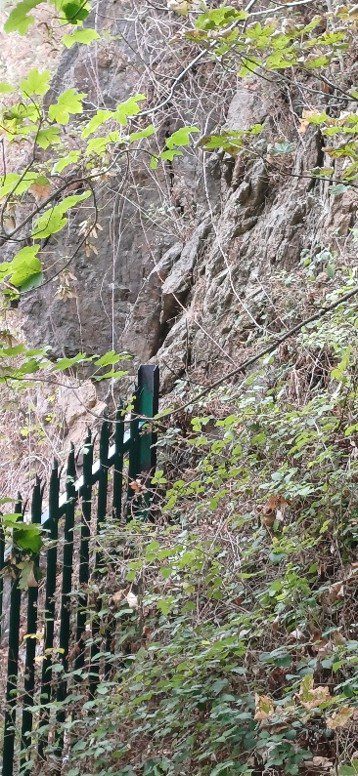
The quarry face was inaccessible, being fenced off. The view of the rocks was poor due to tree growth around the lake margins within the quarry. The exposure within the quarry contained the early Silurian May Hill sandstone, which has been intruded by a number of granitic dykes. The Mayhill sandstone is a greywacke being composed of micaceous shales interbedded with sandy siltstones.
To the right of the fence in the picture, beds of well foliated mica schists reportedly form the base rock – now covered in vegetation. Pieces of the mica schist can be found amongst the trees in the soil on the slope.
At Hangman Hill we were to get to examine the Warren House Volcanics. These are a 566-million-year-old suite of submarine volcanic rocks found in the Malvern Hills, Worcestershire. Best known for their spilitic basalts, these rocks originated as lava on an ancient ocean floor near the edge of the supercontinent Gondwana.
At Hangman Hill Quarry the exposed rocks are reportedly dominated by black ignimbrite at the south end of the quarry and a grey-coloured, very fine-grained rhyolite towards the north end of the quarry.
Saturday am 12/9/26: Wesbury Garden Cliff. Severn Estuary northern side.
Westbury Garden Cliff provides an important sedimentological record of changing environments from terrestrial, hypersaline sabkha plains (Mercia Mudstone Group) to shallow marine (Penarth Group). The red rocks that make up most of the lower part of the cliff are known as the Branscombe Mudstone Formation, previously known as the Twyning Mudstone Formation; the overlying buff and green-grey layers belong to Blue Anchor Formation. Above the Mercia Mudstone Group are the Westbury Formation and Lilstock Formation both belong to the Penarth Group.
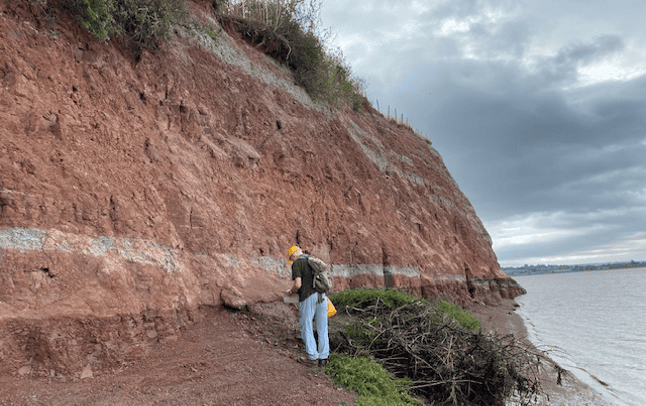
(The overlying Blue Anchor Fm is exposed in the next cove along, but the tide did not recede sufficiently for access).
The green mudstone contains ferrous iron (Fe²⁺), whereas the red ferric mudstone has been oxidised (Fe³⁺). Oxidation can occur with exposure to air. Reduction can occur with the inclusion of organic matter. Small amounts of Gypsum can be found in the cracks within the cliff face.
The afternoon exposure entailed driving to Hock Cliffe located on the southern side of the Severn Estuary to examine the Penarth Group, Lilstock & Westbury Formations. This entailed a drive in heavy traffic taking some quite a time to get there giving others an extended lunch break.
Hock Cliff is located in Fretherne, and represents the finest (Lower Sinemurian) Blue Lias Formation and basal Charmouth Mudstone Formation section in the Severn Basin. It differs substantially in thickness from correlative strata on the Dorset coast, north Somerset coast and the Bristol–Bath area, thereby providing information on regional differences in subsidence rates.
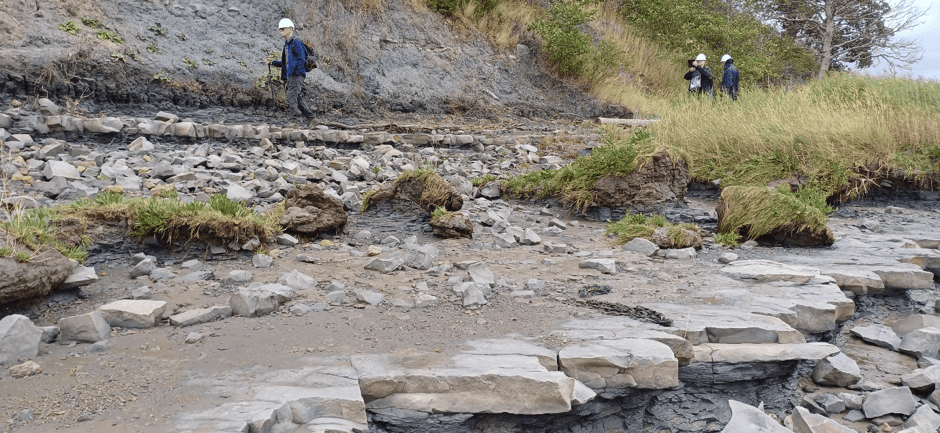
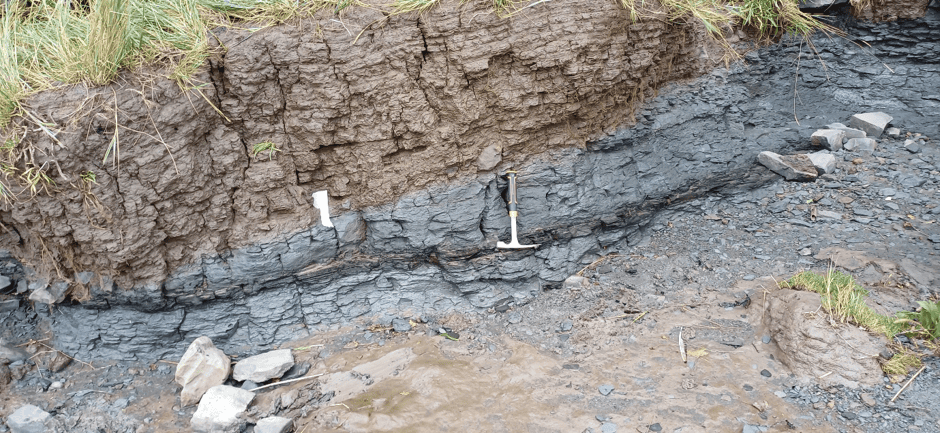
These beds are overlain and underlain by a medium grey laminated mudstone, exhibiting cyclic deposition as a consequence of oscillating water depths, the limestones being deposited in the shallower water. We counted a total of 15 limestone bands representing 15 lowstand periods, in this cyclical succession. The mudstone beds were moderately hydrophilic, despite being c. 190mya.
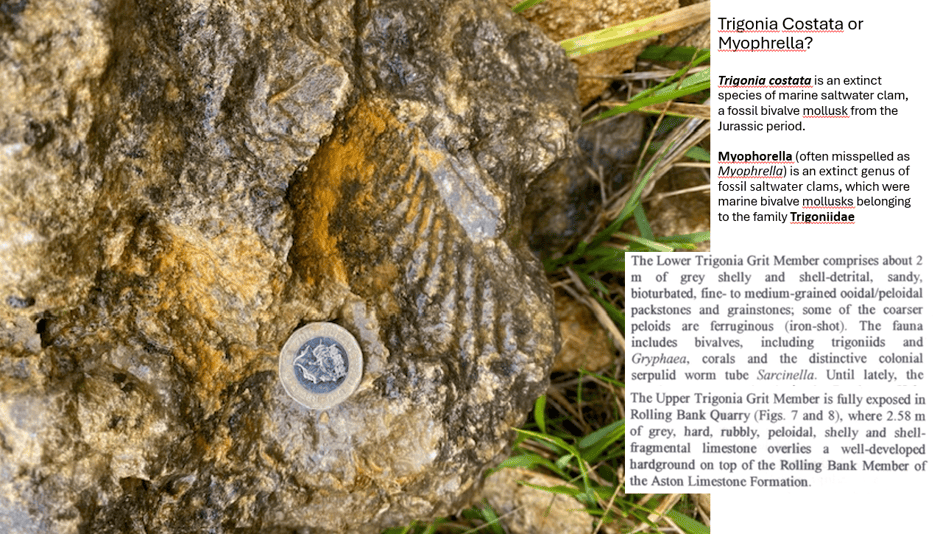
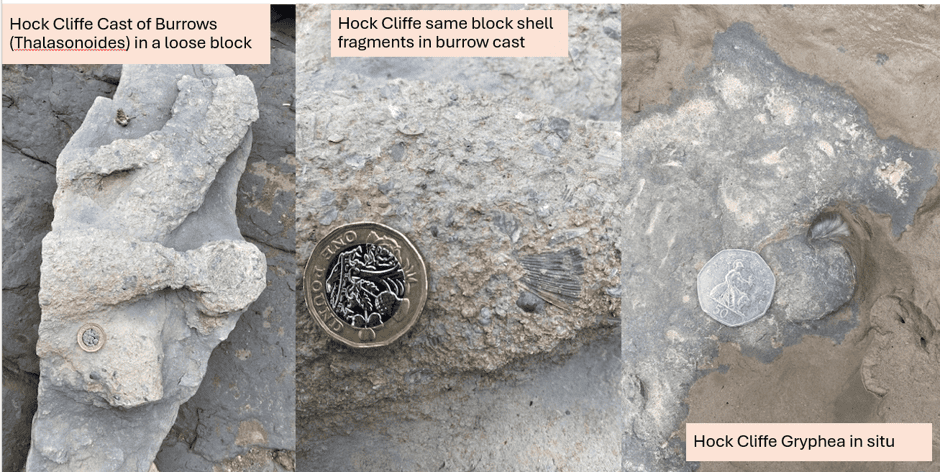
Shells and fossil fragments were fairly common in the more calcareous units. Gryphaea bivalves were very common along this stretch of the river bank.
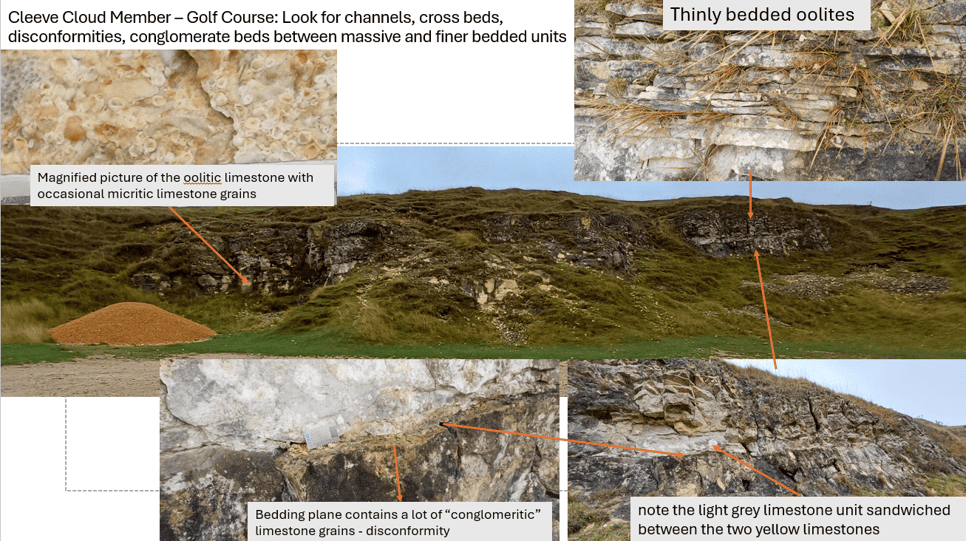
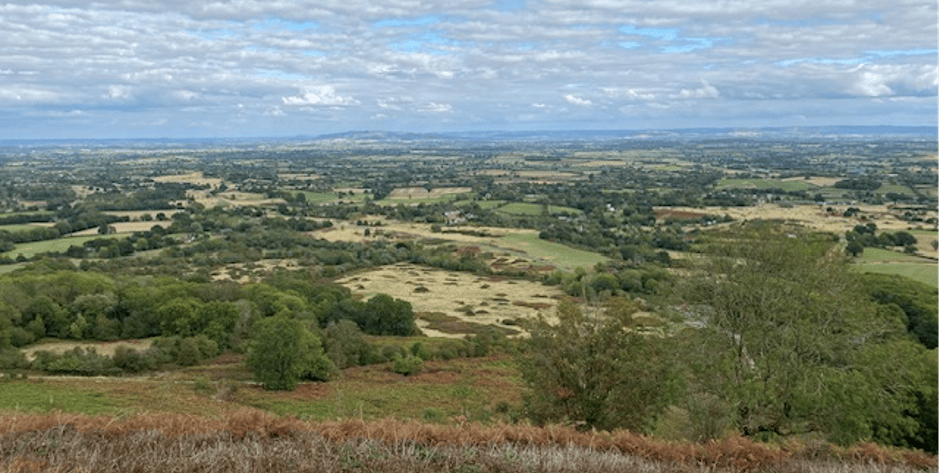
Cleeve Hill: The third day of this trip took place on Cleeve Hill to explore the Cotswolds Middle Jurassic deposits. The traverse began by the radio masts on Cleeve Hill, making our way westwards to Cleeve Hill Golf Course. At 330m, Cleeve Hill is the highest point of the Cotswolds hill range. The numerous old quarries on Cleeve Hill provide the most complete sequence of Middle Jurassic Inferior Oolite rocks in the country, including some not seen anywhere else.
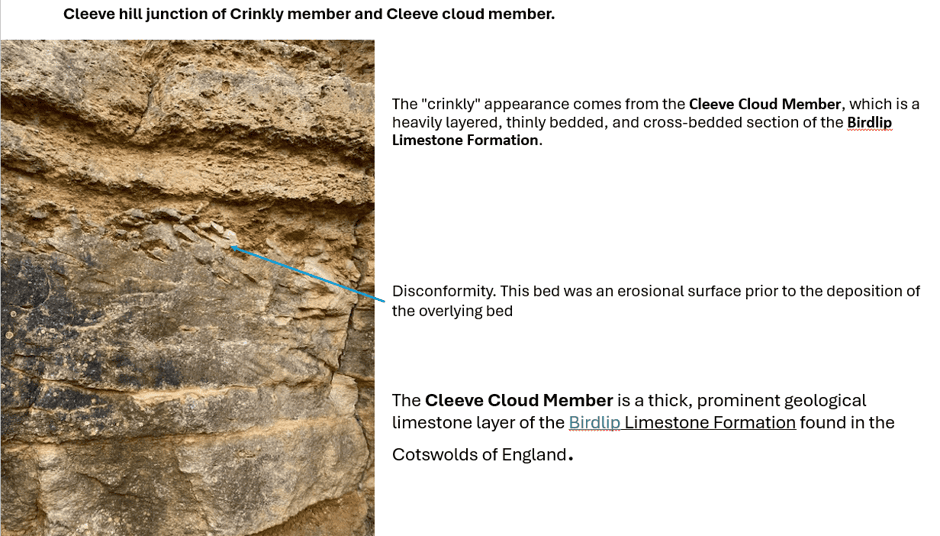
Our route took us up through the stratigraphic column from the top of the Leckhampton Member overlying the Lias Group, up through the Lower Inferior Oolite, (Birdlip Limestone Formation), and into the Middle Inferior Oolite, (Aston Limestone Formation), before dropping back down to exposures of the Cleeve Cloud Member of the Birdlip Formation by the golf course.
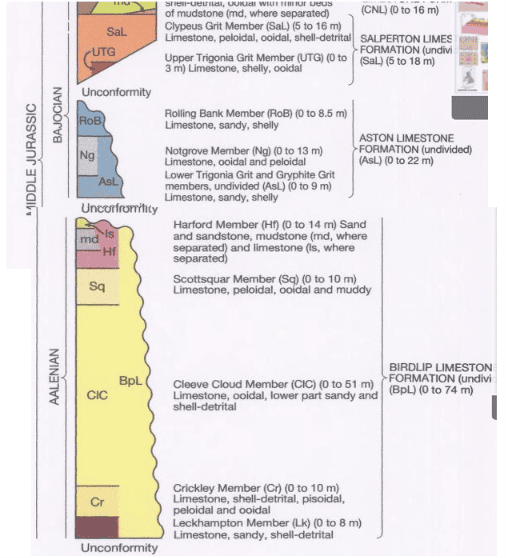
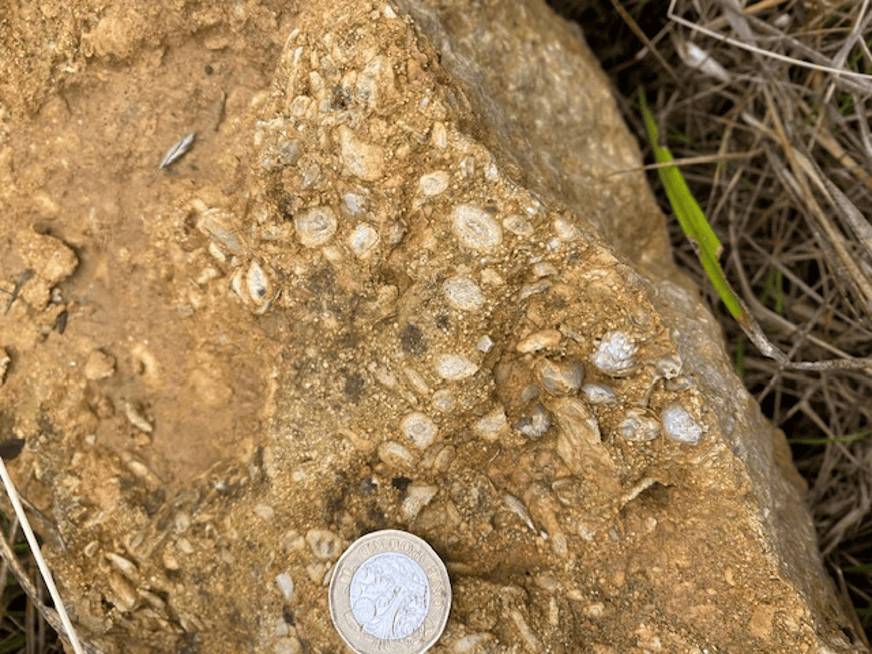
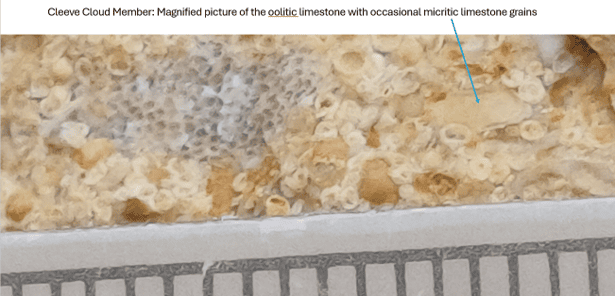
The rocks are dominantly Limestones, commonly containing ooids, peloids, intraclasts and oncoliths that were cemented by a lime water (Sparite) created as shells eroded, or a lime mud (Micrite) produced as calcareous green algae disintegrated. A depositional setting such as we see today in the Caribbean, is envisaged.