Report and Photographs by Ray Pratt and Julie Schroder
The morning involved a walk through the delightful Smestow Valley Nature Reserve where we discussed the geomorphology, biodiversity and local history of the area before visiting a geological exposure of the Triassic Wildmoor Sandstone.
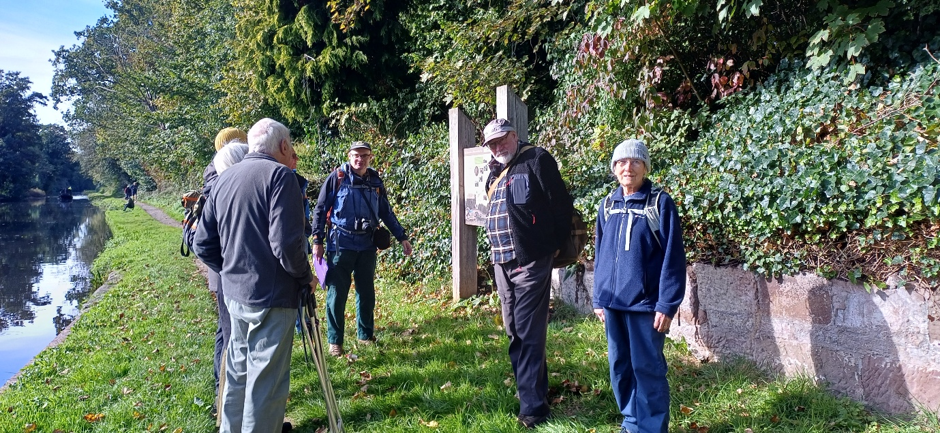
The Smestow river follows an ancient glacial valley which has also been used to construct transport links of canal, rail and road over the past century. Occasional glacial erratics can be seen along the trail and close to the exposure of Wildmoor Sandstone.
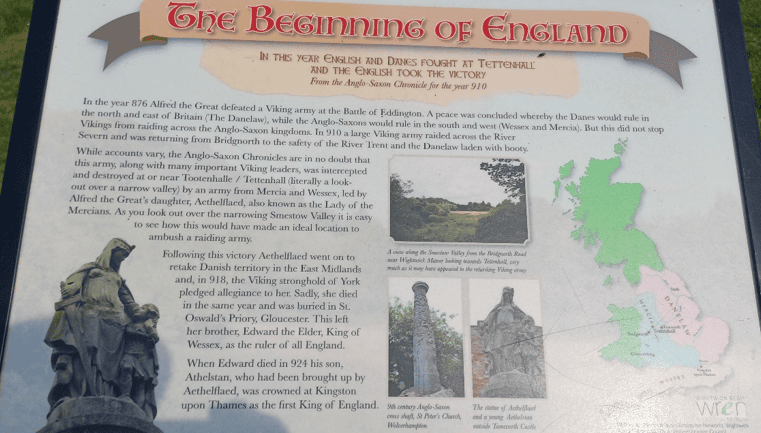
As we traversed the valley we could see remnants of earlier industrial activity. The low-lying land is attributed to infill of earlier quarrying operations today creating lush meadows for nature.
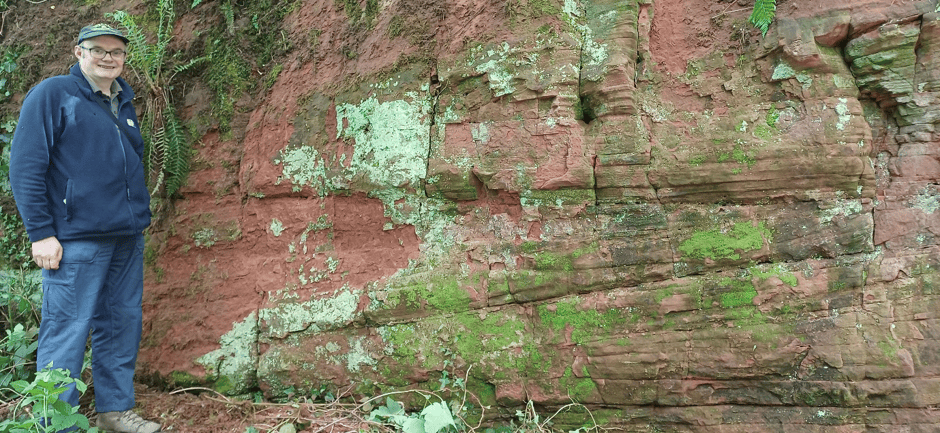
A distinctive channel feature is readily identifiable near the southern end of the cutting. There are several channels identifiable within the cutting, all running west east. The main flow of the river system at that time was believed to be from the Mid Pagngea Mountains to the south, up through the Worcester Graben to the Staffordshire basin. These channels suggest that distributary flows would have ran from the main channel to the west. The overall fine nature and well sorting of the sediments indicates a distal end of the fluvial system of that time. A minimum of 6 flood episodes can be identified in this section. A flooding event begins with erosion of some of the earlier sediment deposits before further deposition takes place, creating cross bedding.
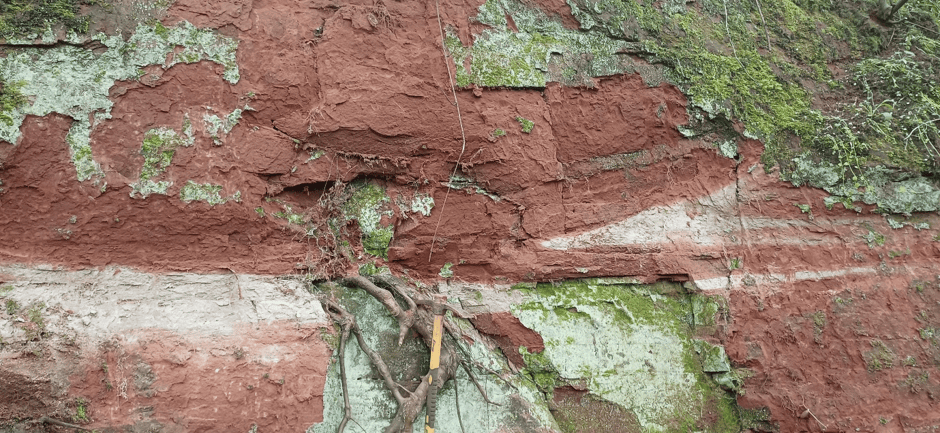
A west east channel is clearly identified following cleaning of this rock face. Small zones of reduction are visible in different parts of the section.
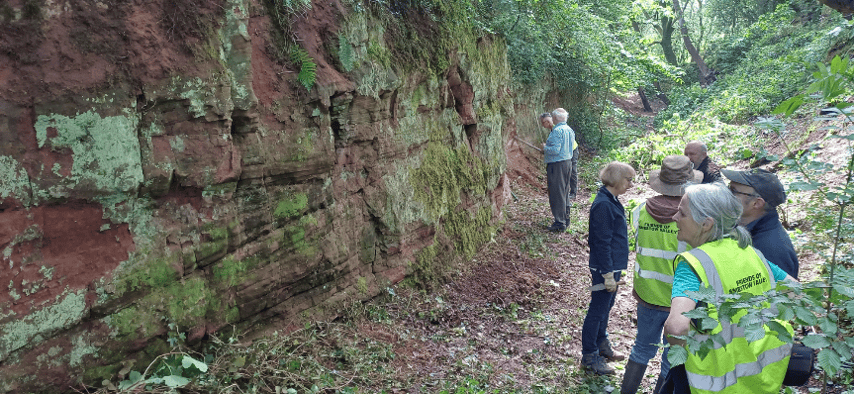
This narrow excavation may have been created for the storage of tools and to provide amenities for the quarry workers during quarrying operations. Its close proximity to the quarry is evident in the following slide.
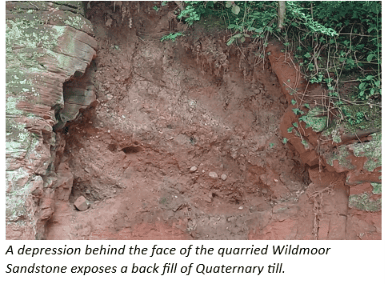
Following a recent BCGS geo-conservation effort, a quarried passage provides an excellent exposure of the Early Triassic Wildmoor Sandstone (Olenikian-Anisian). Deposited in the Staffordshire basin, these well sorted fluvial sandstones display excellent sedimentological features revealing the depositional setting. Local glacial till has been used to infill the quarries A break in the wall of this passage exposes the till which was banked up against the side of the quarry.
A short video of this cutting can be seen on YouTube: https://youtu.be/0lLNtNE9NNA
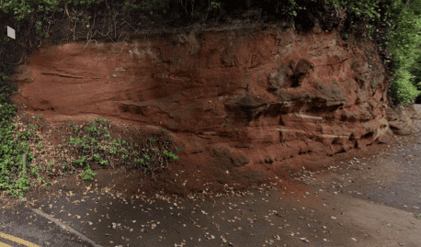
Wightwick Bank road cuts through the grounds of Wightwick Manor. This excellent exposure of the local early Triassic Wildmoor Sandstone bedrock, which formed in braided river systems within a desert environment around 250 million years ago, can be seen directly opposite the exit gate of Wightwick Manor.
It is interesting to note that the Mander properties of The Mount, Glen Bank and Wightwick Manor all took advantage of a high ridge of Triassic Wildmoor sandstone which stood high above the industrial heart of Wolverhampton.
The glacial erratics of Wightwick Manor and The Mount Hotel
An array of 19 glacial erratic boulders lies on display at the National Trust’s Wightwick Manor, home to the Mander family and situated close to the Tettenhall Wood district on the western fringe of Wolverhampton. Almost every boulder bears a metal sign indicating its rock type and a general sign explained the glacial origins of the boulders. The Trust’s Wightwick Manor guide book of the time simply states that: “the boulders… were deposited in the area by a glacier in the last ice age.
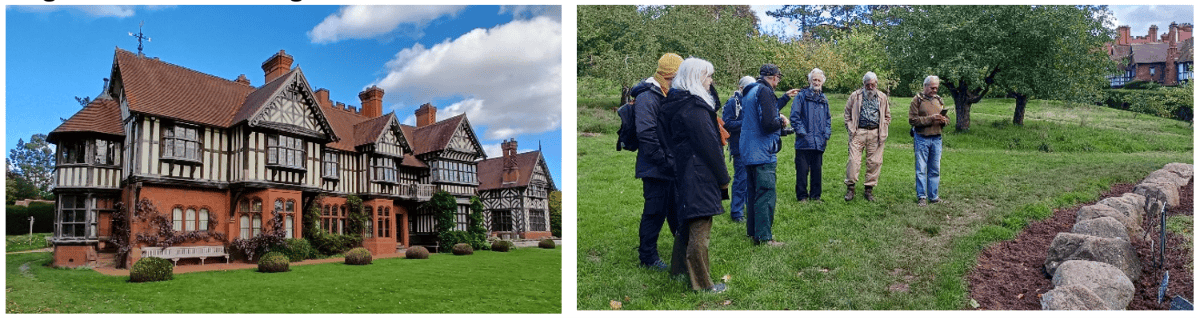
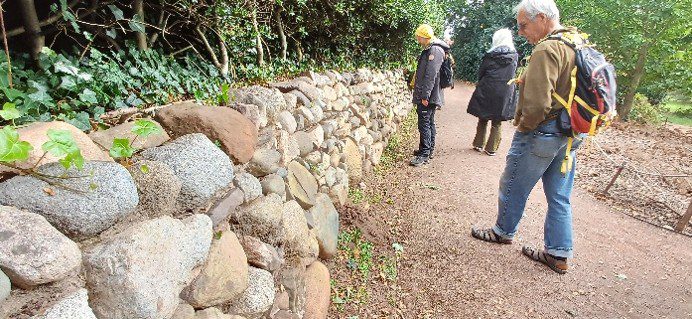
On a site walk it can be seen that hundreds of small glacial erratics are to be found in the Manor grounds, many of them incorporated into walls around the property. These are evidence of significant deposition in this area during the glacial period and these small glacial erratic stones were almost certainly found within the grounds.
The display of 19 labelled large boulders were brought in from The Mount hotel at the time of its sale in 1952, in order to preserve the collection. The Mount, then owned by the Mander family, was the original home of the bouldery collection.
One of the hot topics of geology in Victorian times was the subject of glaciology and the search for evidence of glaciation in the landscape. Glacial erratic boulders provided readily visible clues and they were profusely strewn across the Midlands. There was mounting evidence from the area of two different ice advances, later known as the earlier ‘Anglian’ advance peaking around 450,000 years ago and the most recent ‘Devensian’ advance which peaked around 22,000 years ago. Erratics from Birmingham southwards to Bromsgrove were mostly found to be made of felsic tuff from the Arenig Mountains in Wales belonging to the earlier ice advance, whereas the far more numerous erratics found in the Wolverhampton area were hard granitic rocks, mostly from Criffel Mountain in Dumfries and Galloway (Scotland) or from Ennerdale and Eskdale in the Lake District.
They were very different in appearance and texture from the underlying rocks which are mostly formed of a crumbly red sandstone. The Wolverhampton erratics were found no further south, marking Wolverhampton as the terminus for the Devensian advance in the Midland area.
The Mander brothers, in the mid-19th century, would have been aware of the significance of the boulders through their membership of the Dudley and Midland Geological Society. Apart from their scientific significance, it became fashionable in certain quarters of Victorian Society to have a private ‘bouldery’ consisting of glacial erratics found on their land or acquired by having them brought from their glacial resting places in the local area. Amongst the cognoscenti, this would also have been a gesture to save the boulders from destruction in the wake of urban development.
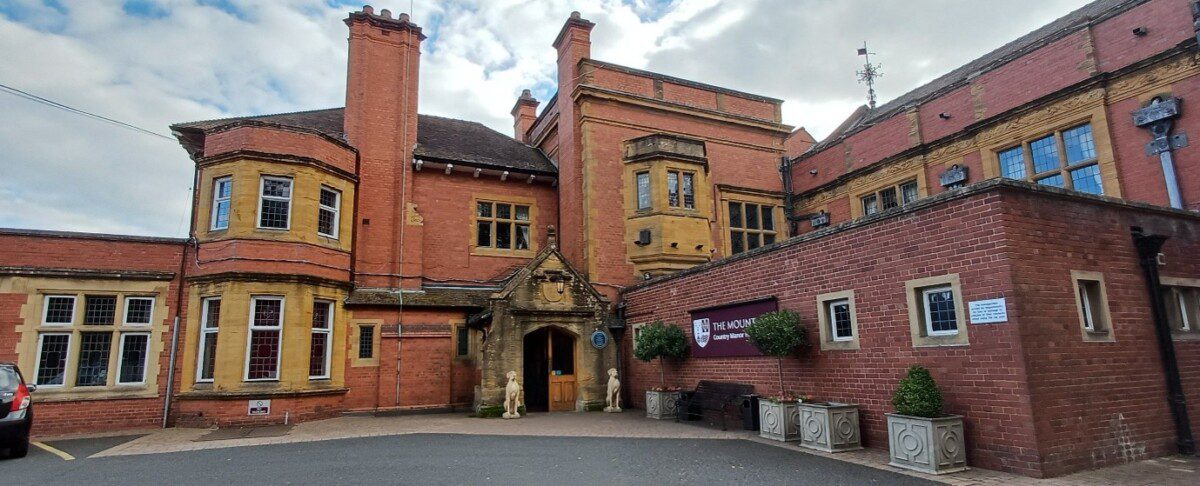
The Mount Hotel
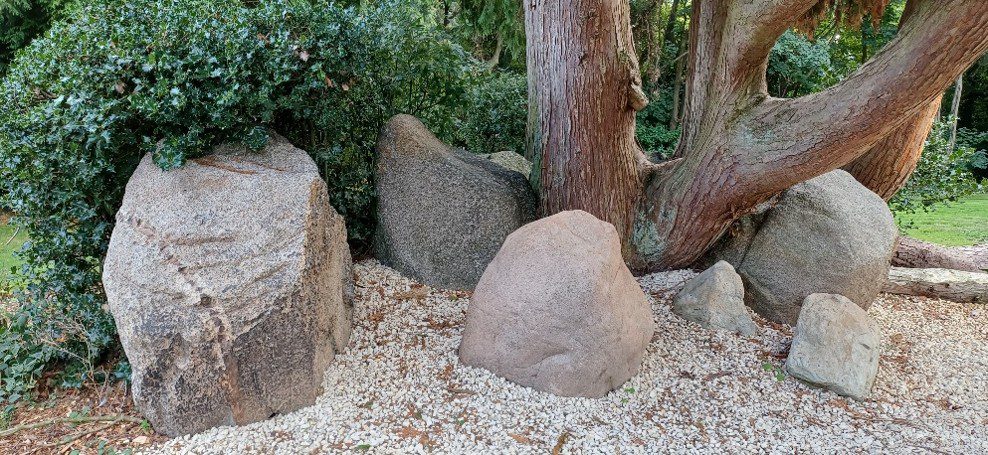
Today, there remain 10 glacial erratic boulders nestling around the base of a large conifer tree within the grounds of The Mount hotel.
These boulders were originally collected by Charles Benjamin Mander around 1860 and put on display in the grounds of his home, the Mount, not far from Wightwick Manor. In 1952 the boulders were rescued and transferred to Wightwick Manor by Sir Geoffrey Mander when the Mount was sold.
Some of these remaining boulders are quite small, but several are considerably larger than those at Wightwick Manor, with the tell-tale hallmarks of Criffel granite and Ennerdale granophyre, (as at Wightwick Manor), confirming that these at least are genuine glacial erratics carried by ice to this area during the Devensian ice advance, to be dumped in their thousands as the ice finally receded around 11,000 years ago.
Sir Geoffrey’s initiative saved the boulders now at Wightwick Manor, and we can only speculate why he left the others behind. It may be that these didn’t fit in with the fairly uniform size scheme of the 19 boulders chosen for his display. It is now more than 70 years since the surviving boulders were abandoned at the Mount, but it is gratifying that they are still there as a feature in the beautiful grounds of the hotel.
For more details on the glacial erratics please refer to articles published in recent BGSS newsletters.
https://bcgs.info/pub/wp-content/uploads/newsletters/BCGS_Newsletter293.pdf
https://bcgs.info/pub/wp-content/uploads/newsletters/BCGS_Newsletter294.pdf