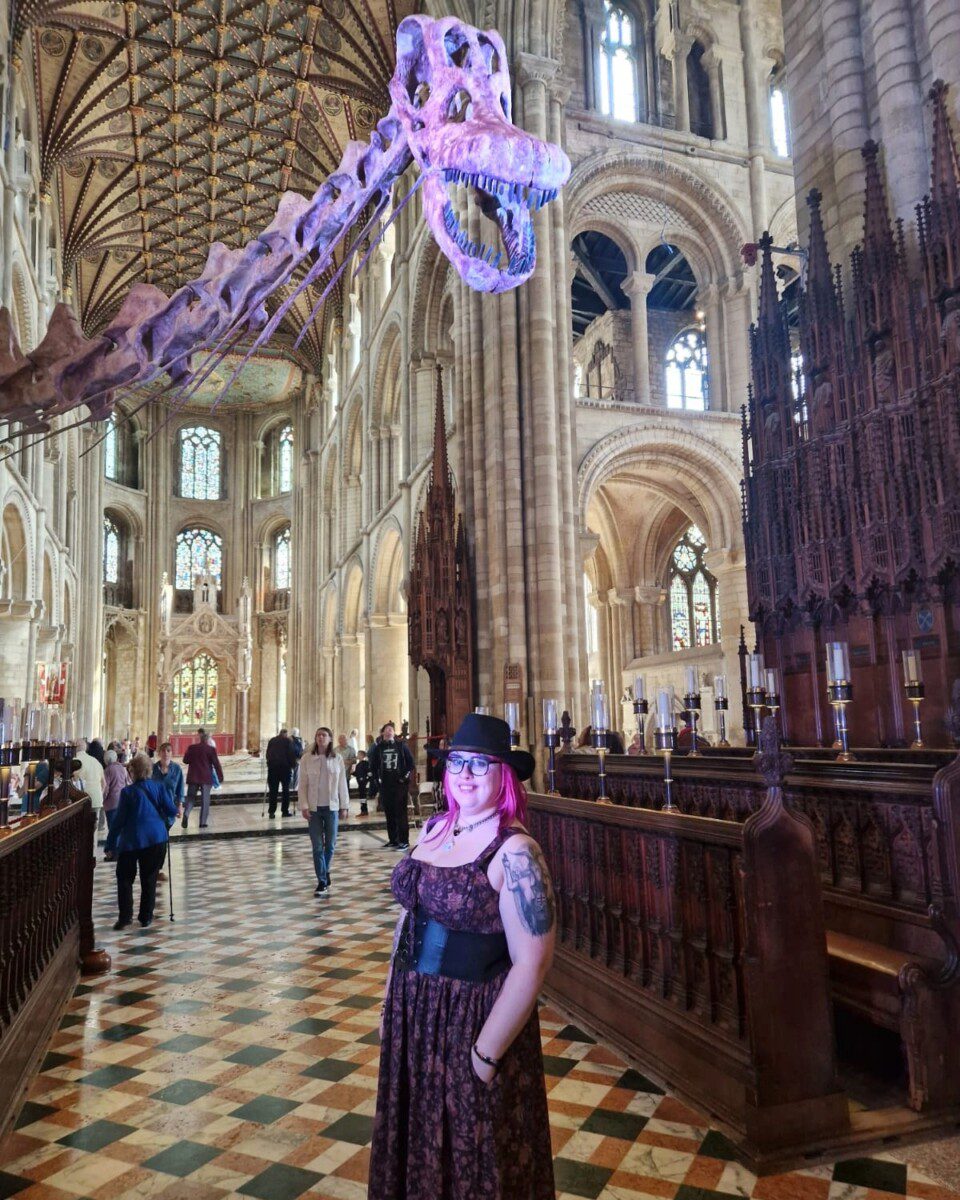
From local geology to wider environmental insights, the Warwickshire Geological Conservation Group’s latest lecture series has covered a wide range of topics. Now that the series has come to a close, I wanted to reflect on what was shared and what stood out from the perspective of a newcomer. Through the charity, I have been involved in reconnaissance of several Local Geological Sites (LGS) over the past year, including Napton, Kenilworth, Southam and Bishops Itchington. It is great to be included in conserving Warwickshire’s unique geological heritage. I have also helped with outreach at Ask A Geologist at the Herbert Art Gallery and Museum (under Dippy the Dinosaur!), and will be back there celebrating GeoWeek 2026 on May 30th – do come along and check out our specimens!
My thoughts are gathered from behind my laptop at the back of the hall, where I have been supporting the delivery of the lectures. This has included reading out questions from our online audience to the speakers. It’s been great to see WGCG offering lectures in a hybrid format, helping to reach a wider audience. From the sessions, it’s clear that people are joining not just locally, but from across the UK and sometimes internationally.
Palaeontologist Dr Ross Anderson kicked off the 2025/26 series by showing us his innovative techniques for examining micro-fossils and their host rocks. Ross told us about his research at the University of Oxford exploring argillaceous rocks and their well-preserved fossils that can reveal how multicellular life first evolved on the planet over 500 million years ago. We lived vicariously through Ross as he showed us photos of an expedition to Canada, where over 100 specimens were collected and returned to the Museum of Natural History for microscopic fossils to be extracted. WGCG Trustee Gareth Jenkins said ‘Ross gave a great introduction to Neoproterozoic evolution’. Indeed, Ross captivated as he presented big findings from such small specimens.
Following the October AGM, PhD student Xiang Yan introduced Helsby Sandstone Formation (formerly known as Warwick Sandstone) and the landscape it came from. The talk took us back around 240 million years to a time of vast rivers and desert dunes, and shared new research that maps these systems across the UK. He included local fieldwork from Warwickshire, helping show what these ancient rivers may have looked like. The field study in Warwickshire showed excellent exposures that do not get the same geological attention as their equivalents across the country. I look forward to the upcoming WGCG field trip to see the Helsby Sandstone Formation at Guy’s Cliff on 27th May 2026 – sign up, and if you see me, please say hello!
November brought a presentation from Dr Chris Rochelle. The talk covered the future of deep geothermal fluids and their role in low-carbon energy. Chris explained how new technologies are enabling access to deeper and hotter resources, alongside examples of geothermal and lithium projects in south west England and ‘superhot’ systems in Iceland and Mexico. He also explored how these fluids can be used across a range of applications, from power generation to heat and mineral extraction. After recently visiting Iceland, where I was interested to see pavements and roads kept ice-free by geothermal energy, this talk brought my amateur observations into context. WGCG member Joe Mazgajczyk was also in attendance and wondered ‘is the phenomenon of geothermal energy the way forward to solve the energy crisis? It would be great to get an update from Chris in the future’.
Starting off 2026, Tim Pharaoh ‘revisited’ the Charnwood Terrane by presenting a new model for how southern Britain’s crust evolved during the Ediacaran period (around 635–541 million years ago). Using geophysical data, the session explored ancient volcanic arcs, basins, and tectonic activity, and challenged previous ideas by highlighting the role of extensional tectonics in shaping the region. A highlight was an image of Tim Pharaoh at the ‘Bomb Rocks’ at Charnwood Lodge, with the dramatic volcanic rocks offering a glimpse into the area’s deep geological past. Gareth commented that Tim’s talk makes us ‘reconsider ancient tectonics and crustal extension’. Revisit the talk on YouTube: https://bit.ly/4d8RI3F
Peter Gutteridge was our speaker in February. Peter took us back over a billion years to explore the Stoer Group, where rocks once thought to be formed by simple chemical processes are now understood to be the work of early microbial life. The talk explained that these structures, called stromatolites, grew in shallow lake environments as microbes trapped and built up layers of sediment over time. Peter offered a fascinating look at what may be some of the earliest evidence of life in what is now Britain, and what these ancient environments might have been like. Prefacing this again, that your author is a novice (with a penchant for all things purple) – what caught my attention towards the end of Peter’s lecture was ‘Purple Earth hypothesis’, which proposes that before green plants took over, early life forms used different coloured pigments to harness sunlight, potentially giving the Earth a very different, almost purple hue.
The penultimate lecture came from Malvern native, Adrian Wyatt. In this, Adrian explored the mineralisation of the Malvern Hills, using the familiar ‘Malvern Stone’ as a starting point. He showed us that beneath its grey appearance, Malvern Stones comprise a mix of minerals and rock types, including granite, diorite, and metamorphic rocks, each contributing to the colours and textures seen when freshly exposed. Through historical research and examples from past quarrying, Adrian showed that although no valuable deposits were found, the hills contain far more geological diversity than might be expected. His contribution to the lecture series also highlighted the valuable role of dedicated hobbyists in geological research and understanding.
Wrapping up the year, Dr Colin Prosser gave his talk on geoconservation. This engaging overview of the history of geoconservation in the UK traced its development from early initiatives such as the 1873 ‘Committee on Boulders’ (which received a chuckle from the room) through to the introduction of national legislation and the more complex systems in place today. Colin explained that geoconservation must balance priorities at local, national, and international levels, alongside the competing values of conserving and reintroducing wildlife habitats and thriving plant life – all things the WGCG consider during our conservation activities. As Joe noted, it was a ‘very interesting talk… given the history of and the sites Colin has been involved with, and it was particularly encouraging to hear that some of these early sites are in Warwickshire and continue to be maintained by WGCG. From a novice perspective, it was especially interesting to see how the field has evolved, and how it now involves navigating multiple layers and competing priorities to protect geological sites in the modern landscape of preservation and sustainability. Colin’s talk is also available on our YouTube channel: https://bit.ly/4eH7h4I
On behalf of everyone at WGCG, I would like to express gratitude to all our speakers for sharing their time and expertise in this lecture series. Fellow members have enjoyed thought-provoking topics from the smallest evidence of life on Earth, new takes on old rocks, through to modern-day challenges in geoconservation locally and worldwide.
Thanks also go to everyone who has attended and engaged with our lectures, in-person or online, and we look forward to seeing you all again. We invite all members to suggest ideas for future speakers, as well as themes for upcoming workshops or seminars. If there is something that you would like to know more about, are knowledgeable on, or have a contact who would like to host, get in touch at [email protected]